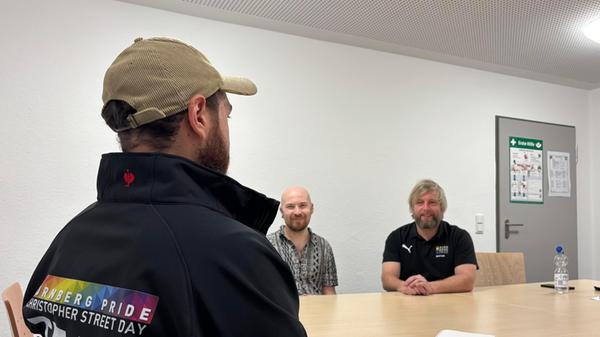
"My life was good until someone found out that I am gay," says Berk. He is sitting in a room in Nuremberg, next to him Tobias Wöhner, who supports queer refugees for the Nuremberg-based association Imedana and the group Fliederlich, and Bastian Brauwer from the Christopher Street Day (CSD) Nuremberg. Berk does not want his last name connected to his homosexuality to be found on the internet. The fear of having to return to Turkey is too great. It is the place he fled from a little over two years ago - and to which he will likely have to return due to what asylum counselor Wöhner calls a "bureaucratic absurdity."
Berk is 26 years old. On this day, he is wearing a cap and hoodie. He studied psychology in Turkey. There, he led what he calls a "completely normal life." But then his father found out that Berk is gay. That’s when all the problems started, he explains in English. His family, as well as parts of Berk’s social circle, are followers of the so-called "Süleymanci," an Islamic group, he says. Especially his father was strictly opposed to his son’s sexuality and even acted violently because of it. "For my father, it’s a disaster that I’m gay," he says, his voice shaking. "My family wanted to ‘correct’ me," he adds, raising his index fingers and drawing quotation marks in the air as he says the last word. Because of this, he saw only two options: live a lie - marry a woman and start a family with her - or choose what he calls "the brave option," to flee. Berk chose to escape.
Felt free for the first time in my life
He came to Germany from Poland and Serbia about a year and a half ago. “No one promised me anything here; hope is what brought me,” he says. Initially, he was housed in Zirndorf, then stayed in the *Langwasser* district of Nuremberg before moving to *Abenberg*, where he still lives today. “For the first time in my life, I felt free here,” he says. From the very beginning, Berk volunteered, as several sources confirm - among them the team of the CSD Nürnberg, a Protestant church in the *Nürnberg-Langwasser* district, and the city mission. He also completed an internship at a nursing home. By then, he had firmly decided on training as a geriatric nurse. Everything seemed to be going well. He had received an offer for an employment contract. Asylum advisor Tobias Wöhner was also optimistic: “I even told Berk, everything is going to work out.” But things turned out differently.
To actually begin the training and thereby at least temporarily stay in Germany, a so-called preliminary approval is necessary, issued by the immigration authority or the employment agency. This allows prospective foreign employees to apply for a visa directly at the responsible foreign mission. According to the Federal Employment Agency, such preliminary approval speeds up the visa process.
The snag in Berk’s case: his Turkish ID card is currently held by the immigration office, according to his lawyer. This is shown in correspondence between her and the authorities, which this editorial team has access to. However, he needs the ID card to apply for a valid passport, which in turn is required to submit the application for preliminary approval in Germany. In theory, Berk could obtain a passport in Turkey, but - this is the argument Berk and his lawyer also present to the authorities - it would come with significant risks: Berk fears violence should he return to his homeland.
Berk’s apprenticeship was scheduled to begin on September 1, 2025. In a letter from the responsible immigration office, Berk’s lawyer reported at the end of June 2025 that this date was unrealistic because the process would take some time. The training provider agreed to postpone the start date if necessary. Yet, to this day, the authorities refuse to issue him the essential document for preliminary approval. According to Berk, Wöhner, and Berk’s lawyer, the authorities say he could simply go to Istanbul, where he could live freely according to his sexuality. In technical terms, this is called an “internal flight alternative.” However, according to Berk and Wöhner, it’s not that simple: “Someone will find me there. I don’t want to spend my whole life running away,” he says.
Furthermore, the cost of living in Istanbul is comparatively high - “it’s like being told in Nuremberg to just move into a villa in Erlenstegen. Not everyone can afford that,” says asylum advisor Wöhner. Ultimately, in this case, it’s about a single document: the preliminary approval. That’s how asylum advisor Wöhner puts it. With this, a proper visa procedure could be initiated, and Berk could start his apprenticeship in Germany. Because: “He actually has the right to stay in Germany because of his upcoming training. But the ‘bureaucratic monster’ makes life difficult for a young gay man,” Wöhner says. Berk refuses to give up. “I have nothing left to lose. I won’t change for my family,” he says.