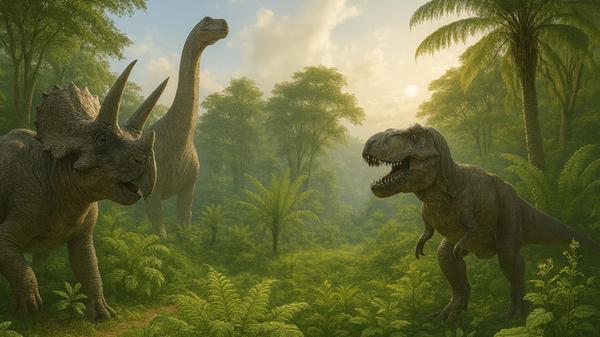
„Experts alarmed: Drastic rise in CO2 in the atmosphere – concentration higher than ever before“ was the title of an article published by dpa on October 15, which also found its way onto the Facebook page of nordbayern.de, where it quickly attracted deniers of man-made climate change like moths to a flame.
This is quite an exciting development, because while not so long ago the most common „argument“ was „but plants need CO2 – so the more, the better“ (which, incidentally, is complete nonsense, as we have already explained here, which is why this point should no longer play a role here), the scene has now come up with something new: it draws on the history of the Earth.
And it goes like this: „Back when the dinosaurs lived, CO2 levels were much higher than they are today! Nevertheless, the Earth was green and alive!“ Sounds like a great argument against worrying about rising emissions – and not only that: in the collection of supposed reasons why we really should leave everything as it is (including the unchecked burning of oil and coal), this is one of the few statements that, for once, is not far-fetched nonsense, but is actually completely correct.
But if you take a closer look (assuming you want to), it quickly becomes clear that this comparison is not only misleading, but also scientifically untenable: after all, it ignores key differences between then and now – in several respects.
Higher CO2 levels? Yes, but...
During the Cretaceous period, approximately 145 to 66 million years ago, the CO2 content of the atmosphere was sometimes over 1000 ppm (parts per million, equivalent to 0.1%), more than twice as high as it is today. The Earth was roughly 6-12 degrees warmer, the polar ice caps were largely ice-free, sea levels were significantly higher, and tropical conditions prevailed even at high latitudes. Due to the humid climate („greenhouse climate“), there were hardly any deserts despite the high temperatures.
However, these conditions did not arise abruptly, but over millions of years – so the Earth had time to adapt to them. In contrast, today’s rapid rise in CO2 is a disruption of a finely balanced climate system that has hardly changed over the last 10,000 years, i.e., since the beginning of human civilization.
Speed is the problem
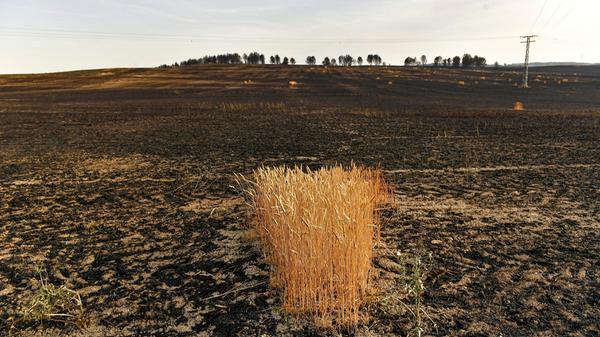
It is true that the Earth has experienced many climate changes throughout its history (which is also one of the favorite „arguments“ put forward by deniers of man-made climate change), but never at the pace we are seeing today. Since the Industrial Revolution, CO2 levels have risen from around 280 ppm to over 420 ppm, representing an increase of around 50 percent in just 150 years. This is a pace that overwhelms plants, animals, and ecosystems, as is already evident today: coral reefs are dying, forests are burning more frequently, animal species are disappearing, and extreme weather events are on the rise.
Human society is also affected—by crop failures, water shortages, climate migration, and increasing geopolitical tensions. Dinosaurs didn’t have to worry about coastal cities, global supply chains, or food production. For us, however, the situation is a little different.
Not suitable for humans
The idea that the Earth was a paradise garden during the dinosaur era is romantic, but at the same time completely unrealistic. Our planet may have been habitable for human-like creatures under certain conditions at that time, but the prerequisites for a complex civilization like ours did not exist: there were no stable coastlines, no temperate climate zones, and no agriculturally usable soil in the modern sense.
Our civilization, cities, agriculture, and infrastructure, on the other hand, depend on a stable, temperate climate. A return to the conditions of the Cretaceous period would therefore not mean a return to lush, flourishing nature for us, but rather a massive threat to our livelihoods. Even a rise in sea level of just a few meters would, for example, displace millions of people and render coastal regions around the world uninhabitable.
Classic case of cherry picking
The reference to the age of the dinosaurs is a classic example of cherry picking: you pick out a detail that fits perfectly into your own world view and ignore the rest. Science works differently, however, because it considers connections, dynamics, and interactions.
CO2 levels are only one part of the climate system. What matters is how quickly it rises, what feedback loops it triggers, and what consequences this has for humans and nature. Research clearly shows that current climate change is man-made, dangerously rapid, and associated with far-reaching consequences. And anyone who downplays this by referring to the Cretaceous period is ignoring the fundamental differences between a primeval world and our highly complex and sensitive civilization today.