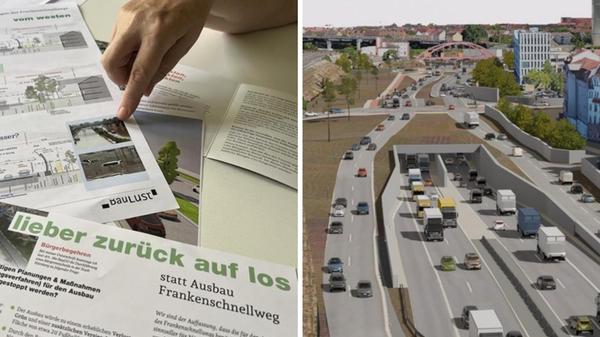
The debate over the expansion of the „Frankenschnellweg“ has been ongoing for quite some time, and public criticism of the project is mounting. The citizens' initiative "Lieber zurück auf Los" criticizes the project and is calling for a fundamental shift in Nuremberg's transportation policy. Central to their efforts is a citizens' petition intended to trigger a referendum. The initiative views the planned expansion as outdated, environmentally harmful, and costly, and is currently gathering signatures.
Criticism of the tunnel project: „Completely outdated“
A representative of the citizens' initiative, the urban planner and architect Brigitte Sesselmann, speaks candidly in an interview: For 20 years, Nuremberg has been fixated on the so-called "tunnel solution" - a concept that is no longer viable today. While other European cities like Paris are scaling down traffic and focusing on more livable city centers, Nuremberg is still planning for a car-centric city. The tunnel is supposed to make traffic disappear underground. However, according to Sesselmann, the changes are minimal: "The tunnels affect just about 20 percent of the total traffic, mostly trucks that only want to bypass the city. We want to spend 700 million euros for this minority. The vast majority, meaning 80 percent of the traffic, remains above ground and does not disappear into the tunnel."
Citizen initiative launched – 12,000 signatures needed
The initiative aims to launch a citizen petition that will lead to a referendum. For this, around 12,000 eligible voters in Nuremberg must sign. If the petition is legally admissible, it will be followed by a referendum - in which at least 10 percent of eligible voters must participate for the result to be binding. In the past, citizen petitions on issues such as land sealing ("Nürnberg grün und lebenswert") or climate decisions have influenced local politics.
"The city's residents think the city council has already decided everything. But that's not the case. The initial expansion in the west has been decided. However, the one in the center of Nuremberg is still pending," said Sesselmann.
Criticism of planning and execution
In Nuremberg's west, an eight-meter high concrete wall is planned for noise protection. However, Sesselmann argues that a speed reduction to 60 km/h would already lead to noise reduction. The massive wall, in contrast, would destroy many green areas and trees.
While the initiative criticizes the approved first phase of expansion in the west, which mainly aims at noise protection, it still sees opportunities here, such as preserving individual trees in the affected urban area.
The city planner is also critical of the planned "green cap." For the expansion, 120 trees would have to be felled. It would take decades for them to regrow to compensate for the loss.
The initiative emphasizes that it does not favor a specific alternative but rather calls for a rethinking: "Back to square one. And rethink from scratch." There are many options; the current course is not the only way.
Criticism of tax money usage
Not least, the project is also a massive financial burden for the city. Even if the Free State of Bavaria covers 80 percent of the eligible costs, the city would still face millions of euros in expenses, as well as additional millions for preparatory measures. Furthermore, many expenses are not yet included in the estimates.
"All the money going into the project are taxpayers' funds. The State of Bavaria also faces a massive backlog in school renovations," stated Sesselmann. She adds that the funds could finance numerous educational projects. For the initiative, it's clear: The money intended for the road expansion is lacking elsewhere - in education, social infrastructure, and climate protection measures.